
AI agents for X (Twitter) growth autonomously identify conversations and draft replies, whereas basic tools merely schedule or draft content. Using agents in 2026 saves founders hours weekly by automating human-approved replies without losing control.
Key takeaways
- Agents decide when to engage; tools wait for your command to post.
- Human approval loops in agents prevent tone-deaf public responses.
- Start with tools for volume, move to agents when conversation context matters.
What are AI Agents for X (Twitter) and how do they differ from AI Tools?
AI agents for X (Twitter) execute multi-step tasks like finding relevant threads and drafting replies autonomously within guardrails. Basic AI tools act as assistants that only process your direct prompt or follow fixed scheduling rules without adapting to new data.
The core difference lies in autonomy. A standard AI tool for X growth might generate a thread draft when you paste a topic into a text box. An agent, however, scans current trends, finds a conversation where your expertise fits, drafts a specific comment, and queues it for your review. This distinction shifts your role from content generator to strategic reviewer. In practical terms, agents reduce the cognitive load of deciding what to say and when. They handle the "finding" work, not just the "writing" work. We see startups save significant overhead by deploying agents that surface opportunities rather than waiting for input.
For developers and operators looking to integrate this, the setup has become more accessible. Describing a task in chat can now trigger complex workflows that interact with APIs, such as posting to X or monitoring mentions. This capability allows teams to build custom automation that understands context better than static scripts. A platform like Latenode illustrates how describing a task in chat allows the agent to execute complex workflows.
When evaluating solutions, check if the system learns from your corrections. A true agent adjusts its future suggestions based on past feedback, whereas a tool simply follows the next command you issue. This learning loop is what separates a smart calculator from a thinking partner.
How do AI Tools for X Growth compare to Autonomous AI for Social Media?
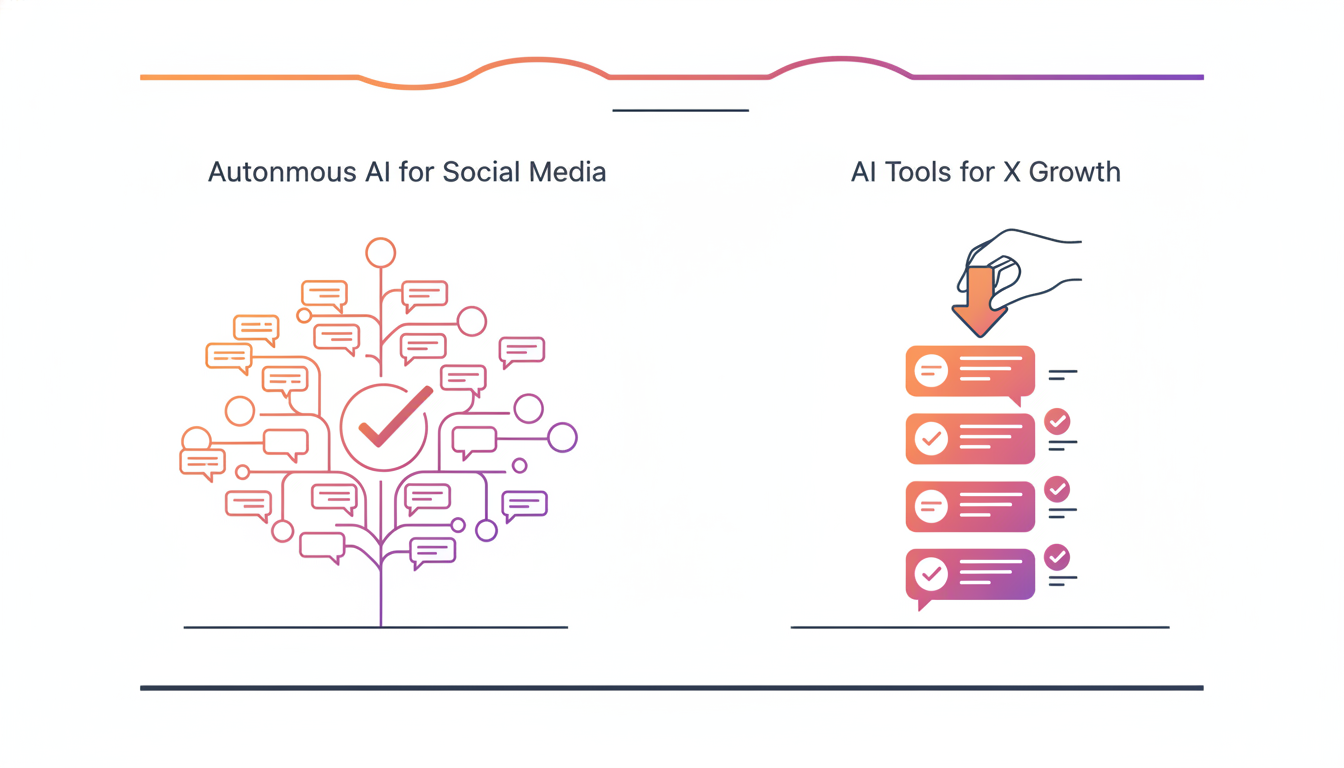
AI tools excel at high-volume content drafting and strict scheduling, while autonomous agents optimize engagement based on real-time context. Tools ensure consistency in posting frequency; agents ensure quality in conversation participation.
The trade-off often comes down to control versus speed. If your primary goal is to maintain a presence with three posts a day at specific times, a standard tool suffices. It can pull from a content calendar and publish without friction. However, if your goal is to drive meaningful engagement and community growth, autonomous agents offer a distinct advantage. They monitor the platform for signals that static schedules miss, like sudden spikes in niche topics or urgent competitor moves.
We have analyzed several solutions to see how they handle this balance. NoimosAI notes that autonomous capabilities help cut costs and save hours by amplifying output. This efficiency is crucial for founders who cannot dedicate full-time hours to social management. Yet, speed without context creates risk. An agent must know when not to reply.
| Dimension | Basic AI Tool | Autonomous AI Agent |
|---|---|---|
| Execution | Reactive (waits for prompt) | Proactive (finds opportunities) |
| Output | Drafts or Scheduled Posts | Contextual Replies & Interactions |
| Context | Limited to input provided | Scans platform for trends |
| Human Role | Author / Scheduler | Reviewer / Strategist |
| Best For | Volume & Consistency | Engagement & Relationship Building |
The table highlights that agents require a more sophisticated approval process. You are essentially trusting software to identify relevance before you write. This requires a trust layer that tools do not necessarily demand. In our own work, we prioritize systems where you can toggle between auto-posting and human-in-the-loop modes depending on the sensitivity of the conversation.
Why Founders Need AI Agents for Consistent X (Twitter) Growth in 2026?
Founders need agents to maintain a 24/7 presence that humans cannot physically sustain. Agents ensure your brand remains visible during off-hours and react quickly to breaking news that static schedules miss.
In 2026, attention on X (Twitter) is increasingly volatile. A simple post at 9 AM might perform poorly compared to a thoughtful reply at 9 PM. Traditional tools force you to pre-determine these moments. Agents allow you to capture the momentum as it happens. They identify questions from potential customers or partners and draft responses instantly. This responsiveness is a key signal of authority and approachability.
However, you must manage the risk of sounding robotic. This is why the technology should serve as a draft generator, not a final publisher without review. If you automate too aggressively, you risk engaging in bad faith or violating platform norms. To mitigate this, look for features that enforce a review step. You want the agent to say, "I found three relevant questions, here are my drafts," rather than sending them directly. Learn more about advanced strategies beyond basic automation for founders here.
The value of an agent is in its ability to scale your voice, not replace it. It handles the repetitive scanning work so you can focus on the nuance of your replies. This division of labor is essential for sustainable growth without burnout. As you expand your network, the volume of incoming mentions will outpace what you can read manually. An agent acts as a filter, ensuring you only see the interactions that actually move the needle.
What to Look for When Evaluating AI Social Media Automation?
Prioritize platforms that offer clear audit trails and adjustable approval flows for every action. Ensure the agent understands your brand voice and avoids topics that could harm your reputation or violate safety policies.
When scanning for the right software, do not just look at feature lists. Look at the workflow. Can you see exactly what the agent proposed before it was sent? Can you train it with examples of your past successful interactions? The best tools allow you to refine the output over time without retraining the entire model. As of September 2026, many new entrants claim autonomy but lack these safeguards.
Community discussions often highlight the practical realities of these tools. Developers share how they built specific agents for tasks like replying to X threads while managing constraints. Community members discuss creating agents for X replies to manage automation constraints. Reading these threads helps ground expectations about what is currently possible versus what is marketing hype.
Look for integrations that fit your stack. If you are already using specific analytics or SEO tools, the agent should feed data back into them. Disconnected systems create silos where you cannot track the ROI of your automated efforts. You need to see which agent-suggested posts drove traffic or leads. This feedback loop is critical for optimizing the strategy. Without it, you are flying blind on whether the automation is working.
How to Balance Human-Approved Automation with AI Strategies?
Establish a workflow where agents draft and queue content but humans approve high-risk or high-impact interactions. Use agents for routine engagement and reserve manual oversight for direct partnership or crisis communications.
The most successful 2026 strategies use a hybrid approach. Agents handle the bottom 80% of volume—simple questions, thank yous, and standard replies. Humans step in for the top 20%—potential customers, press, or contentious topics. This balance maintains efficiency while protecting your reputation. You can configure agents to escalate specific keywords or user levels to your direct inbox.
We often advise teams to start with a "draft only" mode. Let the agent write the replies but require a click to send them. Once you trust the quality and tone, you can gradually automate more categories. This progressive approach prevents the shock of sudden automation. It also helps you gather data on where the agent needs adjustment. For more insights on this transition, check our guide to switching from old workflows to modern agents.
Your strategy should evolve as your audience grows. Early on, personal touch is everything. As you scale, you need systems that replicate that touch at volume. The right tool allows you to maintain both. Do not let the technology dictate the relationship; let the technology enable the relationship.
FAQ
Are AI agents safe for X (Twitter) in 2026?
They are safe if they operate with human approval gates. Unrestricted agents can post inappropriate content, so always require a final review for public replies.
Can AI tools replace manual engagement completely?
No. Tools can draft and suggest, but human empathy is still required for sensitive or complex customer issues. Automation should assist, not replace, judgment.
How much faster are AI agents than manual posting?
Agents save hours weekly by automating search and draft tasks. Exact speed depends on your volume, but most users report freeing up several hours for strategy.
What is the cost of setting up these agents?
Costs vary by platform complexity. Some open-source options are free, while managed SaaS agents charge monthly fees based on usage limits and features.
Do agents work for all X (Twitter) account sizes?
Yes, but small accounts may not need full autonomy yet. Start with drafting tools and scale to agents as your conversation volume exceeds manual capacity.
If you want to try a solution that prioritizes safety and human control, explore FounderReply. We help founders automate X and Reddit engagement without losing their authentic voice.