The short answer: choose an AI content brief generator that pulls live SERP data and structures its output for answer engines — then budget for a human to edit every brief it produces. In 2026 the tools have converged on features and diverged on data quality, and data quality is the only thing that changes your rankings. Manual briefs take 45–90 minutes each, according to Hypertxt's June 28, 2026 comparison of AI content brief generators — that's the number you're buying down, and it's the only number that matters when you're deciding whether the subscription pays for itself.
Key takeaways
- Live SERP data beats model memory. A brief built from a cached index is a brief built on last quarter's intent.
- AEO (Answer Engine Optimization) structure is now table stakes: direct answers, question headings, extractable passages.
- Pricing is mostly per-seat or per-credit; the real cost is the editing time you still owe each draft.
- Model-driven briefs are fine for net-new categories where no SERP exists yet. SERP-driven briefs win everywhere else.
- Never publish an AI brief unreviewed. The failure mode isn't bad grammar, it's confident wrong specifics.
What Are AI Content Brief Generators and Why Do They Matter in 2026?
AI content brief generators are tools that turn a target keyword into a structured writing plan: headings, questions to answer, entities to mention, competitor gaps, and internal link targets. They matter in 2026 because search results are increasingly assembled by AI engines that lift self-contained passages, so the brief — not the draft — is where you win or lose. A brief is a specification. If the spec is wrong, no amount of good writing saves the article.
The category has also gotten crowded. Distribb's roundup of 14 AI content brief generators for 2026 is a reasonable snapshot of how many options now exist for what used to be a manual Google Docs template. Fourteen tools for one job means the differentiation is no longer "does it generate a brief" but "where does the brief's data come from."
How Do AI Content Briefs Actually Work?
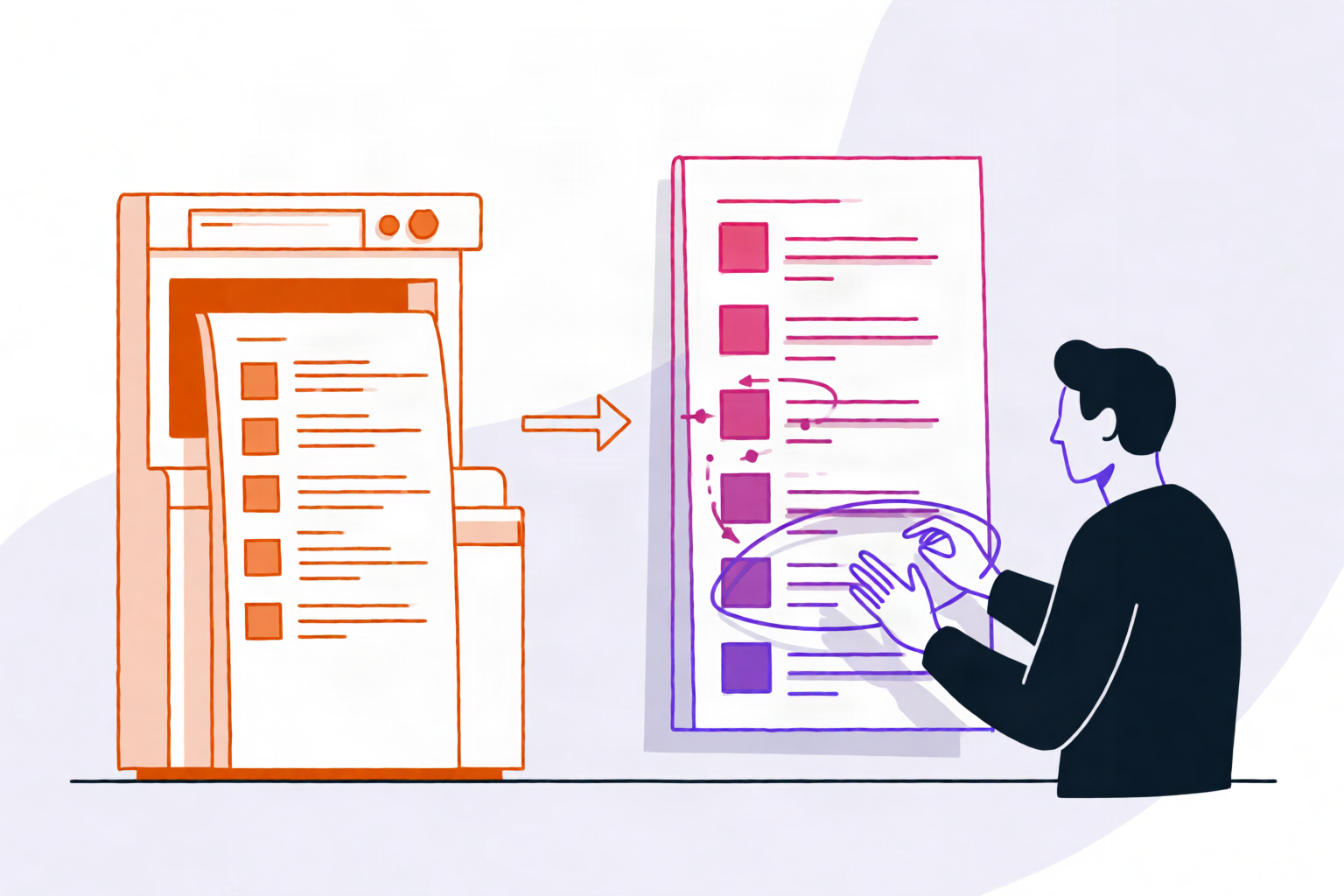
Most tools run the same four steps: ingest a keyword, pull the current top-ranking pages for it, analyze their structure and coverage, then generate an outline plus writing instructions. The differences live in step two. Some tools query live search results; others lean on a model's training data or a periodically refreshed index. That single choice determines whether your brief reflects what's ranking this week or what ranked months ago.
Then comes the assembly layer. Good tools extract the questions real searchers ask (People Also Ask, forums, autocomplete), map the entities and subtopics competitors cover, and flag what nobody covers yet. That last column — the gap — is the only part of a brief that creates an actual competitive advantage. Everything else is table stakes you could get from reading the top five results yourself in twenty minutes.
SERP-Driven vs. Model-Driven AI Briefs: Which Should You Pick?

Pick SERP-driven briefs for anything with existing search demand, and model-driven briefs only for categories where no one is ranking yet. SERP-driven means the tool reads live results and reverse-engineers the winning structure. Model-driven means an LLM writes a plausible outline from its training data. The second is faster and cheaper; the first is accurate.
Where model-driven briefs quietly fail is specificity. A model will happily invent a comparison table structure for a topic where searchers actually want a step-by-step walkthrough, because it has no signal telling it otherwise. SERP-driven briefs can still be wrong, but they're wrong in ways you can see and fix, because you can open the same results and check. If a vendor won't tell you which mode their briefs run in, assume model-driven and price accordingly.
| Brief type | Data source | Best for | Main risk |
|---|---|---|---|
| SERP-driven | Live or near-live search results | Established keywords, competitive topics | Cost, rate limits, stale cache if not truly live |
| Model-driven | LLM training data | Net-new categories, internal docs, pre-launch topics | Confidently wrong structure, no demand signal |
| Hybrid | SERP + model synthesis | Most startup content calendars | Opaque about which layer drove which decision |
Key Features to Look for in an AI Content Brief Tool
The features that actually change outcomes are live SERP access, question extraction, entity and subtopic coverage, AEO-ready output structure, and a workflow path into wherever you write. Everything else — word count targets, tone sliders, readability scores — is decoration. You can add those in the doc.
A practical checklist before you buy:
- Does it pull live results, and how fresh? Ask for the refresh interval. "Daily" and "real-time" are different products.
- Does it output question-form headings? This is what makes passages extractable by AI answer engines.
- Does it flag content gaps, not just coverage? Coverage tells you what to include. Gaps tell you what to own.
- Does it export cleanly? Markdown, Google Docs, Notion, or a CMS integration. If it's copy-paste only, you'll resent it by week three.
- Does it store your brand voice? Generic briefs produce generic drafts.
- Can it handle AEO signals? Direct-answer blocks, FAQ scaffolding, schema hints.
If you're also trying to rank inside AI answers rather than just blue links, the brief is one input among several — the same discipline shows up in how startups use the latest AI models for SEO, where the model choice matters less than the structure you feed it.
Best AI Content Brief Tools: A Comparison
There is no single best AI content brief tool — there's a best fit for how your team already works. Below is how I'd frame the main options, with the question I'd ask a sales rep before committing. Verify current pricing and feature sets directly with each vendor; this category repackages its tiers constantly.
| Tool | Where it tends to fit | The question to ask before you buy |
|---|---|---|
| Gauge | Teams that want briefs as the primary artifact, not a side feature of an SEO suite | How much of the brief is live SERP data versus generated outline? |
| Semrush | Founders already paying for a keyword and competitor suite | Does the brief feature justify the seat cost if I'm already in the suite? |
| Frase | Content teams that want brief-to-draft in one place | How fresh is the SERP data behind the outline? |
| Surfer SEO | Writers who want on-page scoring alongside the brief | Is the brief driving the score, or is the score driving the brief? |
| All-in-one content platforms | Startups that want briefs, drafts, and publishing in one subscription | What do I lose by not using a dedicated brief tool? |
For a broader view of how these tools are positioned against each other, Slate's content brief generator comparison is worth reading alongside this one — different vendors weight different features, and the disagreement is informative.
How Do AI Content Briefs Impact SEO and AI Answer Visibility?
A good brief improves two things at once: it makes your article match search intent more completely, and it makes your article easier for AI engines to quote. Those are related but not identical goals. Matching intent gets you ranked. Being quotable gets you cited in the answer box above the ranking.
AEO signals to bake into every brief:
- A direct, 40–75 word answer immediately under each heading, before any elaboration.
- Question-form H2s and H3s phrased the way people actually type.
- At least one table or checklist per major section — structured data is easier to lift than prose.
- Specific numbers and named sources, because unsourced claims don't get quoted.
This is the same shift driving AI-powered competitive analysis beyond basic social listening: the unit of competition is no longer the page, it's the passage.
AI Content Brief Pricing: What Should a Startup Actually Pay?
Expect one of four pricing models, and pick the one that matches your publishing volume rather than your headcount. Per-seat pricing punishes you for letting a freelancer in. Per-credit pricing punishes you for iterating. Bundled suite pricing is cheapest if you were already paying for the suite. Free tiers are fine for testing output quality and useless for a real calendar.
| Model | Works when | Breaks when |
|---|---|---|
| Per seat | A small in-house team writes everything | You work with freelancers or agencies |
| Per credit / per brief | Volume is lumpy | You regenerate briefs often |
| Bundled in an SEO suite | You already pay for the suite | You're buying the suite just for briefs |
| Free tier | You're evaluating output quality | You need more than a handful per month |
My rule of thumb: if a brief tool costs more per month than the hours it saves you at your own hourly rate, it's a hobby, not a tool. Do that math before the trial ends, not after.
The Human-in-the-Loop: Why Expert Review Is Still Crucial
AI-generated briefs are drafts of a plan, and plans built on scraped competitor structure inherit competitor mistakes. The review step is where you catch the brief telling you to write something factually wrong, structurally generic, or off-brand. It takes ten minutes. Skipping it costs you a published article you have to unpublish.
What to check on every brief, in order:
- Is the intent right? Informational vs. commercial. If the top results are product pages and the brief says "how-to," stop.
- Are the facts checkable? Any specific claim in the brief needs a source before it reaches the draft.
- Is the gap real? A "content gap" that exists because the topic doesn't deserve coverage isn't an opportunity.
- Does it sound like us? If your brand voice isn't in the brief, it won't be in the draft.
There's an ethical dimension here too. Publishing AI-generated briefs and drafts without disclosure or review is the kind of shortcut that ages badly — the trade-offs are covered well in this founder's guide to ethical AI marketing.
How to Integrate AI Content Briefs Into Your Content Workflow
The integration that works is boring: brief → human edit → draft → human edit → publish, with the brief stored next to the published URL so you can audit it later. Most teams break at step one by treating the generated brief as final. The second most common break is not feeding performance data back into the next brief.
A workflow that holds up:
- Weekly: generate briefs in a batch for the next two weeks of content. Batch, don't drip.
- Same day: one person reviews every brief against the checklist above. Ten minutes each.
- At draft time: the writer works from the brief, not from the SERP. That's the point of the brief.
- Monthly: compare published articles against their briefs and note which brief sections correlated with ranking. Delete the sections that never mattered.
If your content operation is one founder plus a freelancer, this is roughly two hours a week. If it's more than that, you need a shared brief template more than you need a better tool.
Future Trends in AI Content Briefing: What's Next for Startups?
The direction is toward briefs that update themselves. Expect tools to monitor published pages, detect when a ranking slips or a competitor adds a section, and regenerate the brief automatically — turning briefing from a one-time task into a maintenance loop. That's already how refresh workflows are heading, and it's the same logic behind hyper-personalized AI agents in social and SEO.
The honest caveat: self-updating briefs will produce a lot of unnecessary churn. A page ranking in position three does not need a rewrite because a competitor published something. Set a threshold before you turn that feature on.
If you want briefs that connect to where the conversation actually happens — Reddit threads, X replies, and the SERP — that's what we built FounderReply to do, alongside the content generation and rank tracking. Worth a look if the workflow above sounds like your week.
FAQ
What is the best AI content brief generator in 2026?
There isn't one. The best fit depends on whether you already pay for an SEO suite, whether you work with freelancers, and whether the tool pulls live SERP data. Test two or three on the same keyword and compare the briefs side by side — output quality reveals itself in about twenty minutes.
Do AI content briefs actually improve rankings?
They improve the consistency of your articles against search intent, which is the part most teams get wrong. They do not fix bad writing, thin sourcing, or a site that can't rank for other reasons. Treat the brief as a specification and the draft as the product.
Are model-driven AI briefs worse than SERP-driven ones?
For established keywords, yes — model-driven briefs lack a demand signal and tend to produce generic structures. For net-new categories where nothing ranks yet, a model-driven brief is often the only option, and it's fine as long as you review the intent assumptions.
How much should a startup pay for an AI content brief tool?
Less than the hours it saves you. Work out how many briefs you'll actually generate per month, multiply by the 45–90 minutes each would take by hand, and compare that to the subscription cost. If the math is close, don't buy it yet.
Can I publish AI-generated content briefs without editing them?
You can, and you'll eventually publish something factually wrong with a confident tone. The review step is ten minutes per brief. Unpublishing a bad article and rebuilding trust with readers costs considerably more.