
AI content distribution for startups isn't about posting more; it's about posting the right piece to the right subreddit or X thread at the right time. It shifts the bottleneck from writing to delivery. When Founder Reports updated its AI distribution tools roundup on August 14, 2026, it listed six platforms built for delivery, not drafting (6 AI Tools That Transform Content Distribution in 2026).
Key takeaways
- AI distribution decides where, when, and to whom content goes; creation is only half the work.
- Reddit and X require different personalization: subreddit culture versus real-time conversation.
- Audience segmentation and adaptive content outperform generic broadcasting.
- Disclosure and platform rules still apply—automation doesn't exempt you from them.
What is AI content distribution, and why does it matter for startups?
AI content distribution is the use of machine learning to route content to specific audiences, channels, and time slots after it has been written. For a startup, that means taking a founder update, product announcement, or SEO article and matching it to the subreddit or X conversation where it is most likely to spark a real reply, rather than cross-posting the same link everywhere and hoping. Creation is no longer the constraint; delivery is.
This shift is already visible in the market. Startus Insights tracks ten AI-based media companies and startups to watch in 2026, many of which are building distribution infrastructure rather than just generators (10 Top AI-based Media Companies & Startups to Watch in 2026).
I learned this the hard way. My first AI-assisted campaign generated three solid articles, then I posted them to the same three subreddits. The moderators removed two, and the third got three upvotes. The problem wasn't the writing; it was that I treated Reddit like a broadcast channel instead of a collection of communities.
How do you personalize content for Reddit with AI?
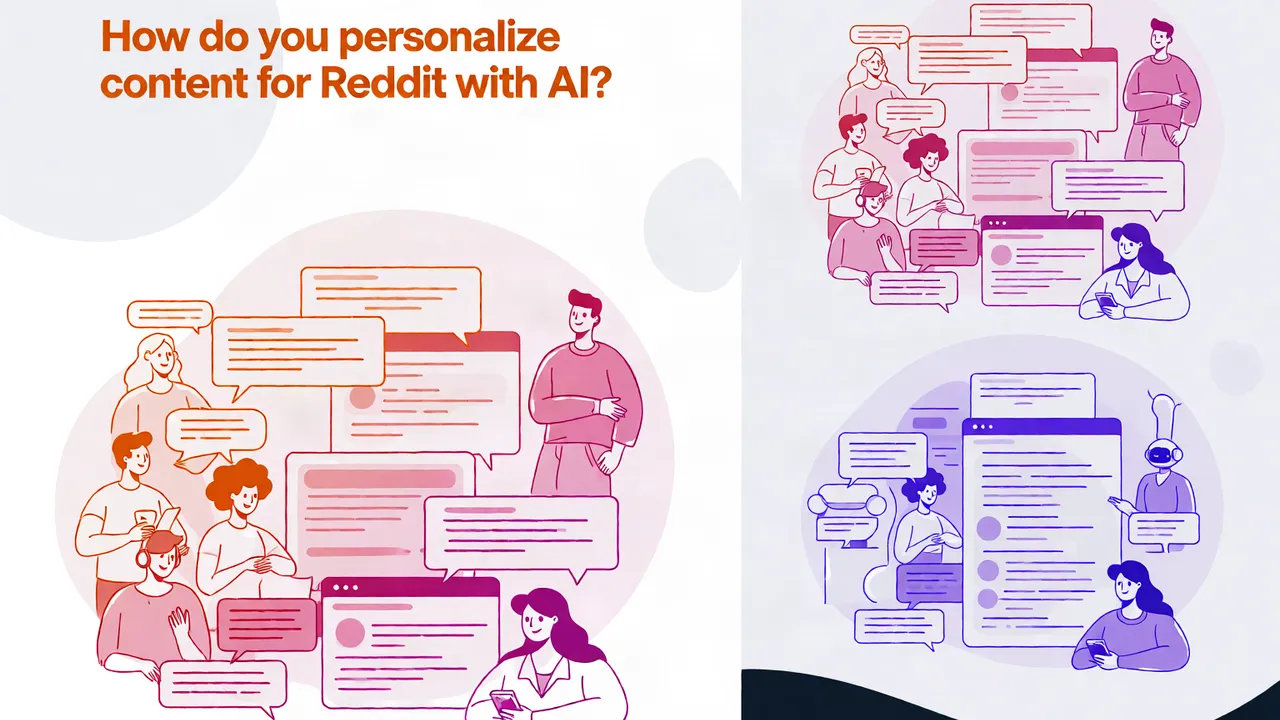
Personalizing for Reddit means matching tone, format, and topic to a specific subreddit's unwritten rules before you hit post. AI can scan a subreddit's recent top posts, identify the language patterns that get upvoted, and flag the self-promotion boundaries that get you banned. The output should sound like a community member, not a press release.
I use a simple rule: if the top posts in a subreddit are detailed stories with data, I draft a detailed story with data. If they are one-liners and memes, I don't post a long-form announcement. AI helps me cluster those patterns quickly, but a human still needs to approve the final draft. For community-level targeting, I rely on community scoring to identify which subreddits are actually high-value for a startup's niche (The Founder's Guide to AI-Powered Reddit Community Scoring: Identifying High-Value Subreddits in 2026).
How do you personalize content for X (Twitter) with AI?
On X, personalization happens in real time. AI can monitor replies, quote tweets, and trending topics to find conversations where your product or perspective is directly relevant, then draft a reply that fits the thread's tone without sounding like a bot. The difference between a useful reply and spam is usually context: knowing what was said five tweets ago.
Because X's API changes frequently, any automation you build has to account for rate limits and authentication shifts. I keep a manual approval step for every AI-drafted reply on X; the AI suggests, I publish. This keeps the voice human and avoids the kind of mass-reply behavior that triggers rate limits or account flags (The Founder's Guide to Navigating X (Twitter) API Changes: Maximizing AI Agent Performance).
What does an AI-powered social media content strategy look like in 2026?
A 2026 strategy splits the week between creation and distribution. Monday might be for writing one long-form piece; Tuesday through Friday are for breaking that piece into Reddit posts, X threads, and replies based on where the conversation is already happening. AI handles the matching and scheduling, while the founder handles the judgment.
I don't recommend fully automated posting for early-stage startups. The risk of tone-deaf distribution is too high. Instead, treat AI as a distribution coordinator: it surfaces opportunities, drafts variations, and suggests timing, but a human presses publish. That hybrid model is what separates teams that build trust from teams that get ignored.
How does AI handle targeted content delivery?
Targeted content delivery means sending a piece of content to the audience segment most likely to engage, based on behavior rather than demographics. On Reddit, that might mean targeting users who recently commented on a competitor's thread. On X, it might mean replying to accounts that engage with your niche keywords.
The practical workflow is: identify intent signals, match content to those signals, then deliver. AI is good at the first two steps. Delivery still requires platform-native formatting—Reddit markdown, X thread structure, hashtag placement. I've seen startups fail here by auto-posting identical text across both platforms. It reads as lazy on Reddit and broken on X.
How does AI segment social media audiences?
AI segmentation on social platforms looks at behavioral signals: which subreddits a user participates in, which accounts they reply to on X, what time they are active, and what topics they share. Instead of broad personas like "SaaS founders," you get micro-audiences like "founders who complain about CRM onboarding in r/smallbusiness."
I segment by intent, not identity. Someone asking about pricing in r/startups is in a different bucket than someone sharing a funding announcement. AI helps me sort those signals at scale, but I define the buckets myself. If you let the model define your segments, you end up with clusters that look clean in a dashboard but don't map to anything you can actually sell to.
What is adaptive content in AI marketing?
Adaptive content is content that changes based on how an audience is responding in real time. If an X thread about your launch is gaining replies, AI can suggest a follow-up post that doubles down on the most-asked question. If a Reddit post is being downvoted, it can suggest pausing or rewriting before you double down on a losing message.
This is different from static content calendars. Adaptive distribution means your plan for Thursday is influenced by what happened on Wednesday. I find this most useful during product launches, when sentiment can shift in hours. The risk is over-optimizing—changing your message so often that your brand voice becomes inconsistent.
How do you maximize reach with AI on social media?
Maximizing reach means amplifying what is already working instead of pushing everything equally. AI can identify which posts are gaining early traction—say, an X reply with above-average reply velocity—and suggest boosting it with a follow-up thread or a cross-post to a related subreddit.
Reach is not the same as impressions. I care about qualified reach: people in your ICP who see the content and take an action, whether that's a click, a reply, or a sign-up. AI helps surface those signals, but the definition of "qualified" is yours to set. Don't let a tool optimize for vanity metrics while your actual pipeline stays empty.
How does AI-driven content amplification work?
AI-driven content amplification uses performance signals to decide which content gets more distribution budget or effort. If a Reddit post is trending upward, the system might recommend a repost to a sister subreddit or a summary thread on X. If an X post is flat, it recommends moving on.
The framework I use is simple: measure early velocity (replies, upvotes, clicks within the first two hours), then allocate follow-up energy to the top 20 percent of performers. This is not about gaming algorithms; it's about not wasting time on content that the audience has already told you it doesn't want.
| Platform | Signal AI Watches | Amplification Action |
|---|---|---|
| Upvote velocity, comment count, subreddit rules | Cross-post to related subreddits, draft follow-up | |
| X (Twitter) | Reply velocity, quote tweets, profile visits | Thread continuation, quote-tweet reply, DM outreach |
| Both | Sentiment trend, click-through rate | Pause underperforming posts, double down on winners |
How do you measure AI content distribution and iterate?
Measure distribution by outcomes, not activity. Track referral traffic, sign-ups from specific subreddits or X threads, and reply quality—not just likes or impressions. AI can aggregate these signals across platforms and suggest which distribution patterns to repeat.
I review distribution performance weekly. If a particular subreddit consistently sends qualified traffic, I increase investment there. If a content format (say, founder story vs. product update) performs better on X than Reddit, I shift the mix. Iteration is the point; without it, AI distribution is just faster spraying.
What are the risks and ethical limits of AI content distribution?
The biggest risk is pretending a human wrote something when it didn't, or worse, flooding communities with low-value AI-generated posts. Both Reddit and X have rules against spam and undisclosed self-promotion, and enforcement is getting tighter. Disclosure laws for AI marketing are also evolving, so you need to know when you must label AI-generated content (AI Marketing Compliance in 2026: A Founder's Guide to Navigating New Disclosure Laws).
I never let AI post without human approval, and I disclose when appropriate. The communities you are trying to reach can usually tell the difference, and they punish inauthenticity faster than algorithms do.
How do you implement AI content distribution at your startup?
Start small. Pick one platform, one micro-audience, and one content type. Use AI to draft variations and identify timing, but keep a human in the loop for publishing. Once that loop is working, expand to the second platform.
Here is the checklist I follow:
- Audit existing content for distribution candidates
- Define micro-audiences by intent, not demographics
- Map each content type to a platform-native format
- Set up AI-assisted drafting with human approval
- Track early velocity signals (first two hours)
- Amplify top performers; pause the rest
- Review weekly and reallocate effort
If you are still writing everything by hand and posting manually, you are not ready for AI distribution yet. Fix the creation bottleneck first. If you are creating consistently but not reaching the right people, that is when AI distribution pays off.
If you want to see how this works in practice, FounderReply is built for exactly this workflow—finding relevant Reddit and X conversations, drafting human-approved replies in your brand voice, and tracking what actually moves the needle (FounderReply).
FAQ
How is AI content distribution different from AI content generation?
Generation writes the content; distribution decides where, when, and to whom it goes. Most startups already have generation covered; distribution is where they lose reach.
Can AI personalize Reddit posts without getting banned?
Only if a human reviews them. AI can match tone and spot subreddit rules, but automated self-promotion without oversight is still a fast track to a ban.
Does X (Twitter) API access limit AI distribution?
Yes. API rate limits and authentication changes mean any X automation needs human approval and careful quota management.
What metrics should I track for AI distribution?
Track referral traffic, sign-ups, and reply quality by source. Impressions and likes are vanity metrics unless they convert to qualified interest.
Do I need to disclose AI-generated content on social media?
It depends on the platform and jurisdiction, but disclosure is increasingly required for marketing content. Check current rules before you automate.